The McErlane
family
John McErlane (1862-??) was born in Ballynease, County Derry
but spent most of his adult life in Scotland. John married Elizabeth Clyde (1864-1895)
in Dumbarton in 1885; Elizabeth was born in Scotland (Old Monklands) to Irish
parents, William & Sarah from Aghaderg, County Down.
The couple had five children and their birthplaces bear testament
to the itinerant life of the Irish navvy in the late nineteenth century. Jane,
born 1886 Queensferry (Forth Rail Bridge); Margaret, born 1888 Clydebank; Henry
born 1889 Port Glasgow: Sarah born 1890 Port Glasgow; John born 1895, Partick.
Partick, Glasgow
In the late 18th century into early 20th
century Partick was transformed from a village to a busy, industrial part of
the city, with an influx of ‘migrant’ workers – mainly Irish emigrants and Scots
who had made their way south from the Highlands. In 1851 the population of
Partick was 17,000; by 1901 it had reached 54,000.
Tenement housing was built to cope with the population
growth but the tenements became (famously) overcrowded themselves. Partick /
the West End was (and is) an area where some of the richest Glaswegians lived but
Dumbarton Road marked the class divide – the poorest classes lived to the south,
closest to the River Clyde.
Grace Street
At some point between 1891 (when the census recorded the
family as living in Port Glasgow) and 1895 John, Elizabeth and family moved to Grace
Street in Partick, where John worked as a Shipyard Labourer.
Grace Street is no longer there but was just south of
Partick Cross. You can clearly see the street pattern from the ordinance survey
map of 1894 preserved in the modern street layout (Google Maps).
1894 Douglas Street = Purdon Street; 1894 Kelvin Street =
Keith Street.
Grace Street has gone but it’s easy to figure out where
it was…the tree just at the end of Walker Court marks the line where Grace
Street ran along.
Grace Street
houses
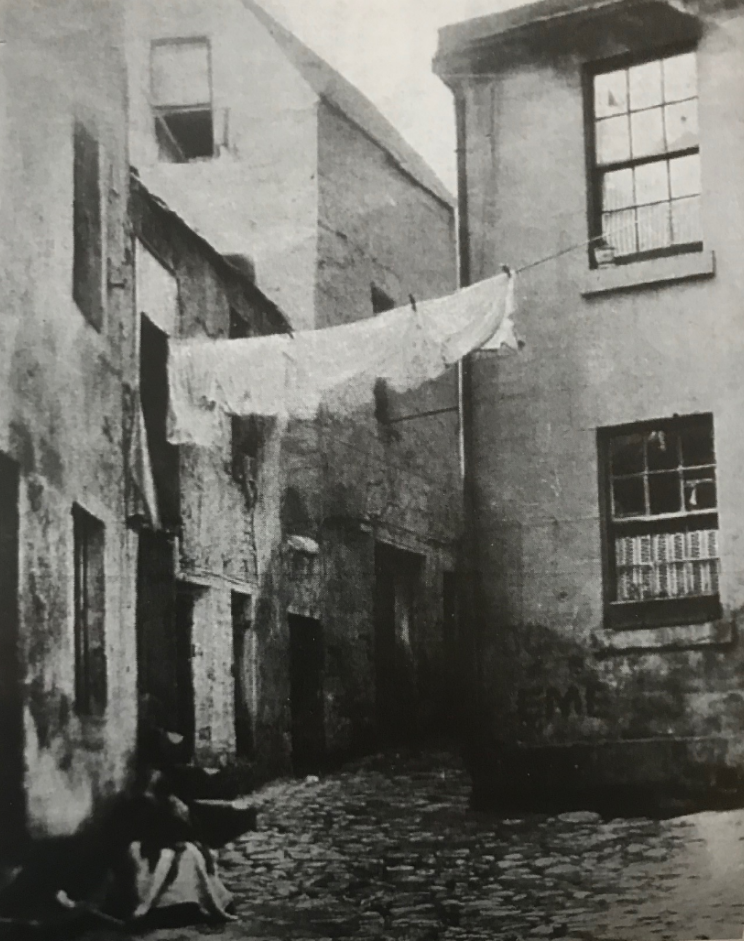
I can’t find a photo of Grace Street (yet) but this is an
old postcard (1901) of Kelvin (or Keith) Street, just a few steps away. These
particular houses were demolished in the 1930s – no doubt Grace Street met the
same fate at the same time.
Elizabeth Clyde
McErlane
Elizabeth died at 9 Grace Street, Partick on 4th
October 1895, just a month after her child John was born. She died of
gastro-enteritis and cardiac failure, aged 31.